The Popcorn Isn't Real · Ep. 1 (Return to Oz (1985))
Return to Oz Is a Dissociative Cover-Up for a Drowning
A nameless girl drowns escaping Dr. Worley's clinic with Dorothy. Everything that follows is Dorothy's trying to make it not-her-fault.
The case, in one place
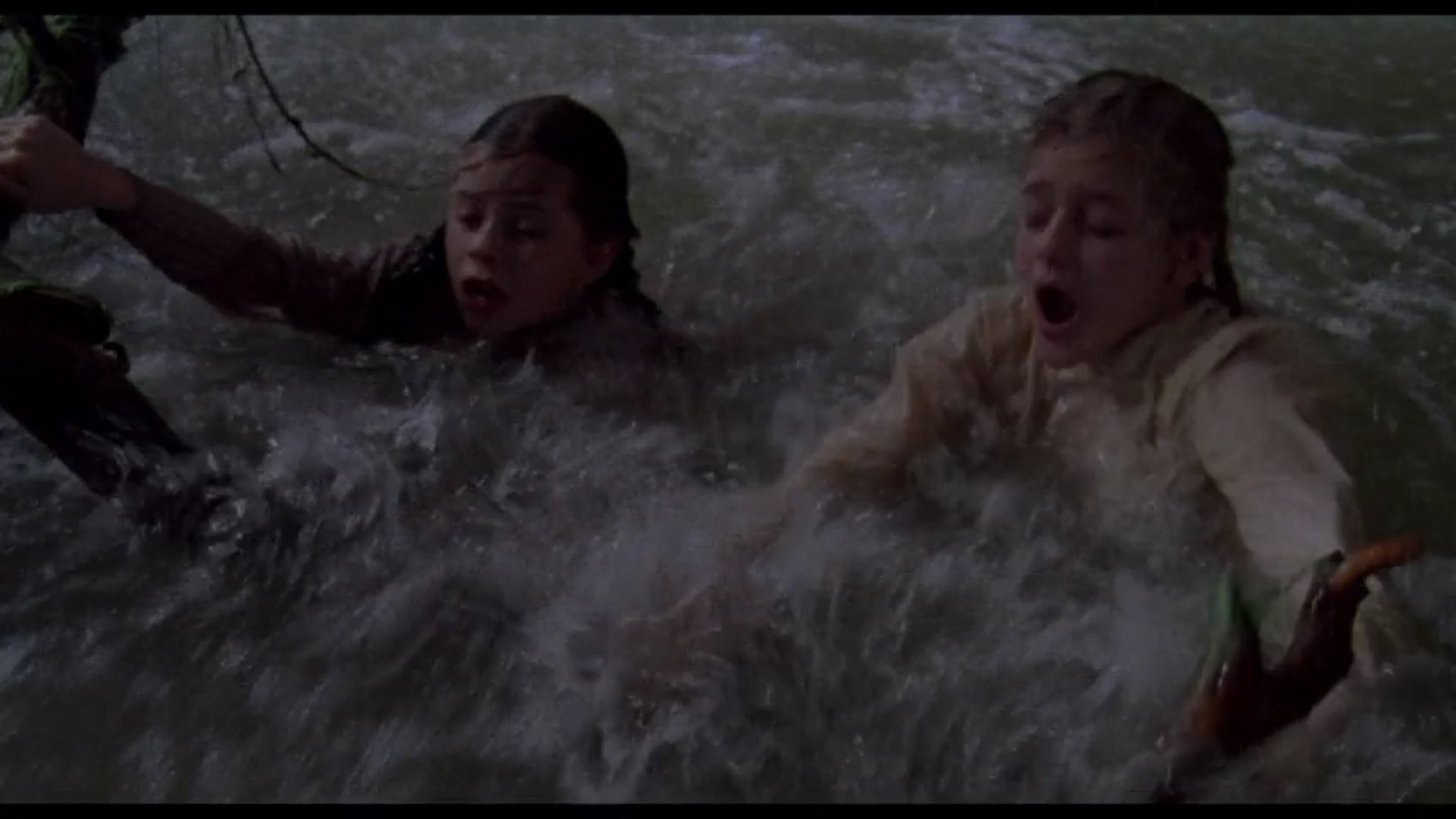
A young girl drowns at the start of Return to Oz, and the entire film is the dissociative fantasy Dorothy's mind builds to absolve her of the guilt. Dorothy escapes Dr. Worley's clinic with another patient, a nameless girl we'll call Ozma-IRL. They fall into a flooded river. Dorothy surfaces. Ozma does not. A child just watched another child drown an arm's length away, helpless to save her, so she does the only thing she can do. She dissociates back into the safety of Oz.
Inside the fantasy, her feelings of guilt rewrite themself. Dorothy is cast as a bringer of life: she winds Tik-Tok back to life, ties Jack's body together, and animates the Gump with the Powder of Life. The Nome King becomes the scapegoat, the death-bringer who turns the living to stone, to sand, to lifeless ornaments, taking away every life Dorothy gave. The film's whole thesis, that the tragedy was someone else's fault, plays out in the characters' actions in Oz.
At the climax Dorothy reaches into a mirror and pulls Ozma out, and as Ozma emerges, the reflection in the mirror turns to water. As if Dorothy is lifting the drowned girl from her watery grave. But her subconscious knows. The last image of Ozma before Dorothy returns to the real-world is a sad, regretful face with rippling water superimposed over it. Dorothy's real last memory of the girl sinking, is bleeding through her fantasy. Then Ozma tells her she can return to Oz whenever she likes, a dissociative refuge built to protect her from every trauma still to come.
Return to Oz is a masterpiece about a little girl trying to cope with repressed trauma, watch it in this light and you'll never see Oz the same way again.
The evidence
Two Patients Run for the Door
Lights out, straps off, into the storm.
It starts in the real world
Aunt Em brings Dorothy to Dr. Worley's clinic to have her sleepless nights and bad dreams shocked out of her. During the electroshock prep the power fails, and another young patient, a barefoot, silent girl, frees Dorothy and pulls her out into a raging storm. The caretaker and orderlies (whom Dorothy will reimagine as Mombi and the Wheelers) give chase. This is the last stretch of the real world before Oz.
Only one girl makes it out alive
Dorothy surfaces. The other girl never does.
The death that starts everything
The two girls fall into a flooded, overflowing river and are swept downstream. They catch hold of a floating piece of wood. The girl sinks and is never seen again. Dorothy goes under, comes back up, and a chicken coop flips upright for her to climb into and float to safety. A child has just watched another child drown an arm's length away, unable to do a single thing about it.
Guilt Splits her Mind
She doesn't wake by the river. She wakes in Oz.
So the mind escapes
Dorothy loses consciousness in the river and wakes in Oz. Everything that follows is her subconscious building a story that shields her from the guilt of surviving when the other girl drowned. The original film already established that Oz lives in Dorothy's head and protects her from trauma; this theory just asks what her head was protecting her from this time.
Mombi Only Knows what her current Head knows
A mind in pieces, by design.
Trauma, dramatized as a prop
Princess Mombi keeps a gallery of interchangeable heads and has only the memories of whichever one she happens to be wearing. It is a literal picture of a fractured mind: a personality split apart so it never has to carry the memory it is running from. Dorothy built that image because it is exactly how her own mind is coping.
I WILL GIVE YOU REST
Two girls in a frame on Dorothy's wall.
The film tells you its subject
On the wall of Dorothy's room hangs a framed picture of two girls, one blonde and one brunette, captioned I WILL GIVE YOU REST. If we take this to be a depiction of Ozma and Dorothy, it personifies the entire film: Dorothy is trying to lay the memory of the drowned girl to rest.
But Was Ozma Even Real?
The one real objection, and the answer is YES.
Was Ozma imaginary?
The obvious rebuttal: No one but Dorothy ever sees or interacts with the nameless girl, so maybe she was imaginary, just the part of Dorothy's mind that wanted to flee to Oz. But the real world of this film plays fair. No talking animals or Oz creatures wander the farm. Whatever Dorothy meets in reality, is real. And every figure she meets in Oz turns out to be built from a real-world counterpart. Therefore, the little girl in the institution really existed, and Ozma was the result of Dorothy's mind re-interpreting her in Oz.
Strapped Down, She Couldn't Free Herself
Someone with hands had to undo those straps.
The single best proof
Dorothy is buckled onto the electroshock gurney and cannot get loose on her own. The girl unstraps her so they can run. A figment of Dorothy's imagination cannot physically free her body. A real person with hands did this. The little girl was a real person standing in that room with Dorothy.
Every Oz character Has a Real Twin
Jack is the pumpkin. Tik-Tok is the machine.
Pattern says she had a counterpart
Oz isn't woven from nothing, it is stitched together from Dorothy's life. Jack Pumpkinhead is the pumpkin the girl hands Dorothy. Tik-Tok is Dr. Worley's electroshock machine. The pattern is consistent, every Oz character is a real thing or person reskinned. So Ozma, the radiant queen, must have had a real-world original too, the quiet barefoot girl who walked in with a pumpkin.
The Cut Line That Says It Out Loud
"God willing they find her too, poor thing."
The confirmation
In a deleted scene, after Aunt Em and Uncle Henry pull Dorothy from the riverbank, a constable drives up and asks if they've seen any sign of "the other one." Henry says no, half the search party is still working further downriver. Aunt Em says, "God willing they find her too, poor thing." There it is, right in the script. A second girl existed, was lost in the same river, and the adults are still out searching for her.
In Oz, Dorothy Only Gives Life
She winds up, ties together, animates.
The fantasy casts her as a savior
Watch what Dorothy actually does in Oz. She winds Tik-Tok up and brings him to life, she ties Jack's body together and brings him to life, and she fetches the Powder of Life to animate the Gump. Over and over, the fantasy hands her the role she could not play in the river, she gets to be the one who brings the dead back to life. This is her mind insisting: I give life, I do not take it!
Belina Stays Behind So She Never Dies
The favorite hen who can't be cooked, remains in Oz.
The same trick, scaled down
Before the clinic, Dorothy learns Aunt Em means to cook her beloved hen Belina for dinner. Belina was left back at the farm, yet she materializes in Oz out of nowhere and, at the end, chooses to stay. Dorothy's mind quietly assumes Belina is dead by now and keeps her alive forever inside the fantasy, sparing herself one more loss. It is the drowned-girl mechanism in miniature. What the real world takes, Oz preserves.
The Nome King Is the guilt She Won't admit
He turns the living to stone, sand, and trinkets.
Someone else has to be guilty
If Dorothy is the life-bringer, the Nome King is built as her exact opposite, the death-bringer who turns living Oz citizens to stone, melts Wheelers into sand, and collects her friends as lifeless ornaments, undoing every life she gave. He is the scapegoat her mind needs. The death wasn't mine, it was his. His clinic, his patient, his storm. The villain carries the guilt so Dorothy doesn't have to.
Each Victim Makes Him More Real
Lose Oz, and the nightmare turns to flesh.
What he really represents
Every time the Nome King turns a friend into an ornament he grows more real: from stop-motion, to a man with a rock-beard, to a man with a real beard made of hair. He says that once Dorothy is an ornament too, no one will be left who remembers Oz, and he will finally become a real human being. That is Dorothy's deepest fear dramatized! The moment the clinic erases her fantasy, reality is all that's left, and she has to live in it.
An Egg Kills the Death-Bringer
The original symbol of life is fatal to him.
Life is poison to a guilty conscience
What destroys the Nome King is an egg, the oldest symbol of life there is. By swallowing it, he swallows the very thing Dorothy is terrified she destroyed, and the guilt that threatened to destroy her dies with him. The film could have killed him a hundred ways, and chose to do it with an egg.
He Greets Her as "Dotty"
Wrong name, and a line the Nome King will reuse.
The clinic bleeds straight into Oz
In a deleted scene Dorothy arrives at the clinic and Dr. Worley greets her as "Dotty." She corrects him, "My name's Dorothy," and he recovers smoothly, "Now, Dorothy, what can I do to make you happy?" That is word for word what the Nome King asks her when she reaches the Nome Kingdom. Worley's snake-oil doctor and Oz's death-bringer speak with the same mouth, the same voice. And the slip is its own little gift to our theory, "Dotty" is a real name, the kind that might belong to the other little girl who walked into that same office.
She Pulls Ozma From the Mirror, and It Turns to Water
The glass she reaches through becomes the river.
Undoing the drowning, Dorothy's final miracle
Crowned queen at last, Dorothy finds Ozma trapped in a mirror and has to reach in and physically pull her out. The instant she does, the mirror's surface turns to water, the very thing that killed Ozma in real-life. Every earlier glimpse of Ozma came through glass. A machine's reflection, a window, this mirror, it is all the same barrier that now keeps the girls apart forever: The river. Here Dorothy finally reaches through it and lifts the drowned girl out of the water she could not save her from.
Water Over a Sad Face
The real memory bleeds through the goodbye.
The mind admits the truth
As Ozma wishes Dorothy home, there is a held shot of Ozma looking quietly sad, and rippling water is superimposed over her face before the scene fades out. An editor wanting a simple Oz-to-reality transition would fade that water straight into the river Dorothy wakes beside. They do not. They fade instead through clouds and countryside, then arrive at the riverbank with almost no water in frame. So the water belongs to Ozma's face, not the transition. Dorothy's true last memory of the girl, the same water that drowned her, surfacing for one moment as she leaves her fantasy behind.
Oz Becomes a Door She Can Open Forever
Look in the mirror, say the word, come back.
A refuge for every trauma to come
Back home, Ozma appears in Dorothy's mirror and tells her she can look in on Oz whenever she likes, and return any time she says the word. Dorothy's subconscious has finished building a dissociative safe room and handed her the key. When Aunt Em checks on her, Dorothy covers and says it was nothing, because somewhere deep inside she knows it is a fantasy and she will not risk losing it. The drowning is buried; the escape route is permanent.
They Asked for a Sequel. He Made a Horror Film.
It was the start and the end of his directing career.
Why the movie is this dark
Return to Oz was Walter Murch's first film as a director and, after it flopped, it was essentially his last. Handed the job of making a children's sequel to the Judy Garland classic, he ignored the task and made a psychological horror about trauma instead. A sleepless disturbed child, an uncle with a broken leg, a mortgage hanging over the family, electroshock therapy from a small-town snake-oil doctor. A kids' movie that reads like a case study in dissociation, and one of the greatest movies ever filmed.
Episode transcript
Hello and welcome to The Popcorn Isn't Real, a podcast where we talk about all things fan theory regarding film. I'm Leif Eric and this is Torvald. That's me. And today we're going to be discussing Return to Oz. So you got Return to Oz on your mind. Why don't we discuss the original? Why don't we skip straight to the sequel? I mean, the reason why is because Return to us is just a really movie right it's yes it's a it's a really good movie um it's i mean we're already losing listeners i don't think most people would agree with that okay well it doesn't matter because we're we're catering to a specific audience it was just us no so it's it's like i think it's one of the like best films ever made i put it in my top 10 of films of all time what's your top 10 films of all time uh soccer almost top secret oh no now we're losing all of our audience yeah i mean we're just telling it like it is i don't think any of those movies are in my top
10 but they're close dude every single one of those is in my top i mean almost here is my top one i mean most people wouldn't even put it on the top list of chris farley films well i'm not most people basically what's great about return to oz first of all it was a complete failure and while you're watching it you understand why because they created a psychological thriller slash horror when they were supposed to be making a sequel to the wizard of oz right and i'm glad that they did that and that they ignored that who who wrote and who directed this movie so walter merch directed this movie it was the start and basically end of his career as a director because it absolutely failed and he's so good right well i mean what i was saying is that i'm really glad that he ignored all logic and made a psychological horror instead of a kid's film because it's a good film but anyway so as we're saying it's a movie about trauma so unlike the
Judy Garland version where everything ends happy and she's like oh and you were there and you were there this one shows just immediately from the get-go the aftermath of the hurricane Dorothy she can't sleep at night she's up at 3 a.m they're in the process of building their house Aunt Em who I always want to call Aunt May is worried because they have a mortgage Uncle Henry's leg is broken so he can like barely move around so right like from the very beginning this is showing like real problems real trauma not the fake like happy that we had in the judy garland version can i just say i love how the in this movie they also do that you were there and you were there but in this movie the people being there is not good like they're they're not her friends um you know in the real world or in her mind right in the first movie everyone she met was someone she liked right yeah right yeah so obviously the whole like theory it was all in her
head that that's not the fan theory i'm going with of course it was all in her head that's confirmed that's confirmed by the original judy garland one and like it's definitely like very much hammered down on in this one that it is all in her head my theory is that dorothy's uh entire fantasy that she goes through during this film is all an effort by her subconscious to alleviate the guilt she feels in the part she played for the death of another patient who was at the doctor's office where she goes to. Yeah, but I'm just like, where are you even getting this? Is it from the scene where she shows up in her room and is petting the pumpkin? Where are you even getting that she ever interacted with uh with that girl i forget her name um well yeah we don't so we don't know her real name right she's osma in the land of oz dorothy is taken by aunt m to this facility this hospital i mean it's just like a little house a doctor's office um where dr worley is going to
use electricity to take all the memories out of her head and make it so she can sleep electroshock therapy. And so the first time Dorothy sees Ozma is when she's looking at the reflection of the electroshock therapy machine, which is what becomes TikTok. And then she turns around and Ozma is looking through a window. The next time Dorothy sees her, Dorothy is in her room and she's looking in a window and then Ozma's reflection shows up again. She turns around and Ozma is standing in right. Ozma's there. Right. And with a pumpkin, which she gives to Dorothy. There's kind of like almost an implication that like maybe Ozma she's supposed to feel a little bit magical like how did she get in the room you know but like the door isn't locked a minute later Dorothy goes to the door and looks it looks like she you can open the door and look outside so it's very possible that there's this is just another patient there this is another little girl who just came in she was
quiet she likes to give people she's not wearing any shoes so she would be very sneaky right so anyway she is the only person who like we don't necessarily know who her real world counterpart is right she's ozma in the fantasy but like my theory is that she was a real person in reality right like that little girl who came in wasn't ozma it was someone okay probably a little girl yeah clarifying question yes so you said that you believe that um just you know as the like the uh the broad view of your theory you said that you believe that Dorothy was involved in Asma's death right and yes that's why okay so you're saying that Asma's death has traumatized Dorothy that's why she's having some bad dreams and stuff that's why she's no no no imagine no we haven't gotten to Asma's death yet Asma is still alive okay sorry I'm skipping ahead you continue then right no but that's a good clarifying question at the beginning Dorothy is just just having issues because of head
trauma because she was in a tornado, right? So that's the reason why she hallucinated this whole fantasy world of Oz and why she can't sleep at night, et cetera. What happens is that the evil lady and the wheeler, the orderlies who become wheelers, they take her and they're going to do the electroshock therapy on her. And then there is a power outage. And of course, Dorothy has been strapped down onto the gurney at this point. But then this little girl who we're going to call Asma, even though that's probably not her name, she frees Dorothy and she's like, we have to get out of here really quick. And so they run and there's people chasing them and they hide in these like lab coats for a sec and then they get outside during a massive storm. Right. And the whole time, this woman who later becomes Momby, she is chasing them. Right. We're seeing this from Dorothy's perspective. She seems like a villain. She seems evil. Right. But really she's
a person who is concerned because two little girls that she's in charge of taking care of are getting away into a big storm. And what happens? Well, they fall into an overflowing river. The woman, Mambi, she falls into the river as well, but she doesn't go down the stream, right? Like Dorothy and Asma are both taken down the stream and they hold on to a piece of something. We don't know what it is yet, but it just looks like a piece of wood. And then Asma sinks as does Dorothy. Then Dorothy comes back up and she has like the, the chicken coop thing has turned over so that Dorothy can get into it and floats away. We never see Asma again, right? No, Asma dead. So Asma drowned just then. Now Dorothy, who ends up losing consciousness and waking up in Oz, her mind is racked by guilt. Even though you could argue this isn't necessarily her fault. Like Asma was this other crazy patient who freed
her and they ran away together she's a little girl and she just saw another little girl die so she's very traumatized at this point so this entire fantasy story that she concocts through throughout the film is all an effort of her subconscious to protect her from that guilt and blame someone else and in the end make her feel like she wasn't responsible and it's okay I see what you're saying. But I guess my rebuttal is mostly based on the fact that Dorothy found a key and was having dreams and was imagining all that stuff before she ever met Ozma, before any of this happened. So Ozma dying is not what made Dorothy crazy, if you're saying Dorothy's crazy. Right, right, right. Dorothy was crazy before. Yeah, no. Right. I'm not saying this is what made Dorothy crazy. Dorothy is already crazy. I'm saying that this story, like the story that happens throughout this film, is her subconscious brain's attempt to protect her from this crippling guilt of possibly having caused someone's death.
What I'm saying is it seems like she was on her way back to Oz anyway in her head, right? Yes. So she didn't really need a reason. She didn't really need a dead friend to get her there. she kind of needed a reason like she's trying to get people to believe her about Oz you know like she can't she can't go back there herself she doesn't know how right no so it takes another trauma you know this time not a hurricane but a different storm to cause the traumatic experience that makes her brain create a new uh situation from my point of view it was unnecessary I think her head was going to take her back to Oz as soon as she got to the hospital she seemed like she already was thinking and dreaming and planning about like us right like that's the whole reason she wouldn't have gone to the hospital if she was healthy she wouldn't have gone to the hospital for electroshock therapy to like the doctor said get all those bad dreams out
of your head right like i mean it seems like like ignoring the first movie if we think of return to on its own, it seems like she's a girl who is having constant fantasies, right? Like she's a girl who is always in her own world or always waking up screaming with nightmares, right? Like it's such a big problem that her family, which as you said, is dealing with whatever problems, right? Like they just had a hurricane, they have broken legs, all this stuff. They're paying to have her undergo expensive electroshock therapy. I'm just saying from the perspective of this movie i don't think we needed a big traumatic event to make this girl crazy i think she was already crazy but with that in mind it's not a stretch to say there's no evidence that she didn't imagine asma right like nothing in there implies that asma was real nothing implies that she wasn't in her head but nothing in the real world as far as we know is fake right like there's
nothing. There are no talking animals, right? The people from Oz aren't just wandering around in the real world. So like, I don't think that her brain is not necessarily mixing reality and fantasy. It's either in reality or she completely dissociates and goes into the fantasy, right? Like she's not like in a constant flux between the two, mistaking them. Like she knows the difference between Oz and the real world. And also like the reason that Aunt Em gives for taking her to the doctor is not like, oh, she's always going to her own little fantasy world. It's that like, she's just not sleeping at night. Right. And we see her at the very beginning. She's not thinking she's in Oz. She's just laying there wide awake. Like she's got issues, but I don't think she's imagining she's in Oz right there. And Aunt Em's whole reason for taking her to the doctor is because Dorothy is no use to her anymore. Like Dorothy can't work because she's tired
because she doesn't sleep anymore. So they're mostly trying to fix that problem of the sleep issue. Yeah. Right. Like Dr. Worley in this movie is depicted not necessarily as a legit doctor, but more as like a snake oil salesman, you know? So it seems like they didn't have a lot of options either. Like they may not have had the option of sleeping pills. When you see their town, it's really tiny, right? Like this is literally the only doctor in town. And yeah, he's got electroshock robots. That's how he doesn't have pills. One thing that I think supports this theory during the actual events of the fantasy, that it's sort of her brain trying to convince her she didn't kill someone and that someone else, namely Dr. Worley or the place where she was, is responsible. I think that there is evidence to support that in the film itself in that everything Dorothy does in this film is bringing things to life so she meets TikTok and she winds
him up and brings him to life then she meets Jack and she has to tie him together and bring him to life and then with the gump she literally has to go get powder of life and bring him to life right Yeah. Whereas the Gnome King is doing the exact opposite, right? He turned everyone into stone. So they were alive. He's making them dead. Then he's later turning everyone into ornaments. They were alive and he's making them dead, right? Yeah. Now, there's something interesting that I noticed while watching it is that every single time that the Gnome King turns one of her friends into an ornament, he becomes more real. So he starts off as stop motion and then he becomes a guy but like his beard is still like foam latex. It's not a real beard. But then after the next person gets turned, he has like a real beard. And he says to Mambi that as soon as Dorothy gets turned into an ornament, there won't be anyone left
who remembers Oz and he'll become a real human being is what he says. So it's an odd thing that they have in there that never exactly pays off. What I think it's supposed to be representing is Dorothy's fear of Dr. Worley taking away her fantasy. And once he takes away her fantasy, then he's real, right? Like, then the reality is what's real. Once everyone forgets about Oz. That's interesting. It doesn't directly support your theory. No, it doesn't. But it is interesting. So I wanted to mention it. No, no, you keep going. I'm just raising an objection. But going along with the life and death thing, like Dorothy wants to convince herself, like she's bringing things to life. She didn't do it. She didn't kill anyone. And the ultimate symbol for life, I would say, is an egg. And what kills the gnome king is this egg. No, it's chickens. I mean, it just happened to be an egg, but he's specifically allergic to chickens.
chickens are poisoned. But like, I would say that this, this egg, like eggs represent life, the life that Dorothy took. And by swallowing the egg, he takes, he's taking the guilt that threatened to destroy her. I think she's swallowing your own eggs here. She is making, her brain is making him into the ultimate scapegoat. Yeah. So that she can move on with her life. Like it's his fault, not her. They were at his clinic and you know, that was his patient she ran away it's not dorothy's fault yeah well to be fair i mean if what you say is true then it is his fault because right it is he's just letting minors run around unattended right exactly no no matter what it's his fault i'm but i'm like from the perspective of a young child you might you know you don't yeah so she saves everyone she goes back to oz she's she's gonna be made the queen um but then ozma shows up right ozma shows up in a mirror and dorothy
Dorothy helps her come out of the mirror. Dorothy has to reach in and pull her out. Now here's an interesting symbol. When Dorothy reaches in and pulls her out, the mirror becomes water, which is what killed Asma, right? And so the mirror becomes water. So this is Dorothy again trying to overcome that guilt. She's resurrecting Asma in her mind. Or saving her, like pulling her out. Yeah, she's saving. Right. Yeah. She's making a reality where it's not her fault. Asma didn't die. And like, I didn't, you know, maybe I didn't save her in the real life, but I'm saving her here. And then, interestingly enough, and this one I think is the biggest evidence of all, is that when Asma is wishing Dorothy back to the real world and everything is starting to turn bright. And Dorothy is saying, goodbye, goodbye, everyone, goodbye. She looks over at Ozma and there's just a shot of Ozma staring at Dorothy, looking really sad.
She's just got kind of this sad look on her face. And then superimposed over her face is water, reflecting water, rippling, reflecting water gets superimposed over her face. But that's just the special effect that they use to imply a transition from Oz to the real world. I would say no. I would say yes. But like, okay, here's the thing. Well, as an editor, when Dorothy wakes up, she is next to water. So as an editor, it would make perfect... She got knocked out in a storm in a river. Yeah, she's on the side of a river. As an editor, it would make perfect sense to have Asma's face, then superimpose water, have the water fade up, have Asma fade out, and then cut to a shot of water that you have just faded to, right? And then show that Dorothy is right next to that water. Okay, that would make sense, right? Like Dorothy's staring at water, so she saw water. But they don't do that. What they do is they superimpose water over her face, over Asma's face, and then they
fade all of that out. Asma and the water go out. And then we fade to clouds. We fade to just this long shot through the clouds, like a helicopter shot just flying through the clouds. And then we go to mountains and we go to the countryside, et cetera, et cetera. And then finally we show Dorothy on the side of the river. We don't even really get any shots of water, right? So like, I'm saying that Dorothy is looking back at her and saying, you know, this is the last, like that would have been her last memory was Asma under the water drowning. And she's looking back, she's seeing Asma's sad face. She's seeing the water superimposed over her face. This whole effort was to convince herself that she didn't do it. But at the last minute, she's kind of remembering the reason she was there to begin with, right? Because she's coming back to reality. But that's not the last time she sees Asma. Right. That's not the last time she sees my asthma. So the next thing I was going to get into is now this is going to get into like MKUltra brainwashing conspiracy theory stuff, which we're obviously not going to get into. But like the idea that when you suffer a traumatic experience, you dissociate, which we know Dorothy does. And that in that dissociative state, you create another personality. And that personality is supposed to protect you from the trauma.
So at the end, when Dorothy is about to go back, she wishes that she could be in both places at once. So we're back in Oz before that shot where the water shows up over Ozma's face. Dorothy wishes she could go back. She could be in both places at once because she's crafted this comfortable world here where she doesn't have to face the tragedy of real life. Fortunately for her, she can be in two places at once if her subconscious creates a split personality. Ozma represents that split personality, right? So like in order to bring Asma back to life, what she actually does is she creates a split personality of herself and her split, her other personality is Asma or what she imagined Asma to be. Like this beautiful queen who everyone loves, right? Even though it was a person that in real life she didn't even know. I feel like the resurrected Asma is Dorothy theory holds true because she pulls her out of the mirror.
And also every other time she saw her was in a mirror and Asma was trapped in mirrors, right? Like it is Dorothy. I mean, I disagree there. Like, I think that this supports a completely different theory, which would be my theory of what Asma is, which is that Asma was just another side of Dorothy's personality all along. Right. Like I would say Asma was always in Dorothy's head and she was trying to pull Dorothy back into Oz. Right. Like she was trying to lead Dorothy to Oz. she was the part of Dorothy's personality that wanted her to escape she wanted Dorothy to go into you know her safe world where she could be whatever she wanted to be and she could meet you know fantastic creatures and people anyway I mean that that's what I see it as is that yeah Osmo was her her split personality the entire time and then I see the ending as her leaving that part of herself behind right like she says I wish I could be in both places but I can't I have to choose one
and this place is yours, that place is mine. I'm splitting from Oz and I'm going to live in the real world. But see, that's the interesting thing about The End is that Asma grants Dorothy's wish to be in two places at once. She says Dorothy can use a mirror to look in on them whenever she wants and all she has to do is say the word and she can come back. Basically, Dorothy's subconscious has created this safe dissociative space that she can use to escape any future trauma, right? Like the first time in the Judy Garland Oz, that was just, you know, head trauma. That wasn't like her, you know, who knows where that came from. But like now, her brain, her subconscious has created this dissociative space to protect her. And she has made a way, a split personality, where she can go back anytime she wants. She can dissociate and then this split personality will take over and protect her from any real life hardship.
And I feel like she in her subconscious knows that it's not real. Because when she does summon Ozma at the end in the mirror, at first she calls Aunt Em over. But then Ozma just shakes her head and then she tells Aunt Em that it was nothing. She doesn't want to destroy the fantasy she created to protect herself because she knows it's a fantasy subconsciously. And so that's why she doesn't ultimately show Aunt Em, even though at the beginning she did really want to prove to everyone that Oz was real. I just don't see how this supports your theory of Asma being a little girl who died. Like this seems to only support the theory that Dorothy has split personalities. Right, right, right. But my theory is that her split personality comes from the trauma of Asma dying. And so my argument against Asma was always her split personality. Ozma always existed is but Dorothy didn't know who Ozma was right no Ozma like if the scarecrow
had walked in from her wanting to get back to Oz right like Ozma's the part of her who wants to go back and that part didn't exist before because she'd never been there before right right right but like my argument against that is no other character who we see in the real world is a fake person yeah that's true so like i just don't think there's any evidence to support that osma was a fake person in the real world like i think she has to have been a real person in the real world okay and then the only explanation for what happened to her is that she died all right then what do you make of belinda coming with her to oz belinda the chicken is the only person who exists in both worlds besides Dorothy. I am glad you asked because that was part of my thing. Let's get into it. So I think that this actually supports the idea that her brain is creating situations to help protect her from trauma. Now, this is a very small trauma, but her brain still protects her from
it anyway. At the end, Balina chooses to stay in Oz. Before going to the doctor's office, Dorothy tells Balina, she's talking to Balina, who seems to be a chicken that she really likes. She tells so that Aunt Em is planning on cooking Bellina for dinner. As Dorothy seems to be very fond of Bellina, I'm sure that Dorothy subconsciously suspects that Aunt Em may do this while she is gone at the doctor's office. So that Dorothy won't make a fuss about it, right? Yeah. And so to protect herself from the sadness of coming home and finding her favorite chicken gone, I think her mind just makes a very simple thing where like Bellina just shows up out of nowhere, right? Like, it's not like Toto. Toto was with her in the first movie. Like Bolina, she left at the farm, right? Yeah. So her mind creates Bolina in this fantasy because she knows Bolina is probably dead at this point and then leaves her in the fantasy so that Bolina can always stay alive.
She's still there. Yeah. Yeah, I can get down with the Bolina theory a little easier than the Osma theory. But the Belina theory, I think, supports the Osma theory because the idea that she's creating another version of this person in her mind who is alive to protect herself from realizing that that person is actually dead. Well, in that case, I think that the biggest omission, like the most glaring fault in your theory is just the fact that nothing recognizes Asma as existing outside of Oz except Dorothy. Like if there was anything you could point to that would say that Asma exists, right? Like any person mentioning her or talking to her or looking at her, but the only person who ever interacts with her is Dorothy, which leads me to believe that Asma is Dorothy saving herself by pulling herself into her fantasy world. Yeah. Like if you could point to anyone besides Dorothy interacting with Asma outside of Oz,
then it'd be easy to buy this theory. Right. Then that would definitely confirm her existence. 100%. Yes. I mean, I think that her existence was specifically left ambiguous, but I would say that at the doctor's office, we know that there are other patients because Dorothy hears people screaming. Yeah. And when Dorothy asks the caretaker woman, Mambi, what that scream was, mom be i forget exactly what she says uh she just doesn't answer her or she doesn't want to talk about it or something like that so i think that that does add at least some slight evidence that there could be other patients that they don't talk about other patients so one of them could be osma could be another patient and even if she did exist they wouldn't talk about her no but then it strikes me as odd that there's no follow-up about the little girl who died at the hospital that night right like Dorothy just kind of goes home and everything's okay and you know like there's
there's no impact I mean I guess you could argue maybe the hospital covered it up or maybe didn't want to bring it up but right but there is evidence that all people who exist in the real world do exist right like Dorothy never imagined anyone else in the real world who didn't exist well but her being real and her being imagined are both equally likely because i mean dorothy does imagine stuff yeah but also there is the question of if dorothy imagined ozma yeah helping her escape and going to oz with her then why does dorothy not why is ozma not with her you know when she first arrives in oz like i think that does help to support the ozma was a real girl who died theory because otherwise she could just keep imagining her once she gets back to oz right Like, why didn't she get into the chicken coop with her, you know? Yeah. Like, why did she just stop imagining Ozma at that point and then starts imagining her again later for no reason?
I don't disagree with that, but I would like to hear what you were going to say a minute ago. So the doctor's office, it is feasible that if they had a little girl there, that they might try to cover it up and not mention it. Or at least, of course, why would they mention it to Dorothy's family, right? Like, they don't need to know. And we know that they would certainly not have any problem doing something underhanded like this because at the end we see the mom be caretaker lady being taken away by the police because that doctor's office was practicing bad medicine. Right. They were doing bad things. She's getting arrested. So like even though they don't say she's getting arrested because they covered up the death of this little girl, it is possible that they could have done that. I'll grant you that. Like that could be she's getting arrested because someone died under their care. right like we don't know why she was arrested but that's very plausible and also dr worley is said
to have died because he went back like he didn't escape the storm he went back in to go save his machines if going back in to save machines gets dr worley killed they're not going to specifically single out this one little girl yeah sure died no i mean that's fair that's fair i also want to point out that there is a deleted scene where dorothy gets to the hospital and where she first meets dr warley and he comes out and meets her and he says well hello there dotty and then she has to correct him she's like my name's dorothy or maybe it's actually her mom that corrects him and he's like oh well sure now dorothy what can i do to make you happy and that's exactly what the gnome king says to her when she arrives in the gnome kingdom anyway doesn't pretty cool yeah Doesn't really prove much in regards to your theory, but it's possible maybe Dottie was the name of this other girl at the asylum or maybe he just or maybe he just read the name Dorothy and then forgot and tried to remember and said Dottie.
Right. It could feasibly be a nickname for Dorothy, too. Yeah. So I'm not going to read too much into that. But I thought that that I thought maybe you'd bring that up as support that there's another little girl named Dottie who looks similar to Dorothy. Thanks for that. Yeah, that that's exactly what it is. Well, as it turns out, there are a lot of deleted scenes and there's there's one. This one is the biggest confirmation of my theory. After rescuing Dorothy next to the river, Aunt Em is hugging her and then the constable drives by and asks if they've seen any sign of the other one. uncle henry says no but half the party is still looking further down river and aunt em says god willing they find her too poor thing oh i mean that pretty much confirms your entire theory without even trying yeah too bad deleted scenes at canon yeah yeah it's true no i mean if if we're gonna if we're gonna get into some conclusions then i will say that uh yeah of course i fully
by your theory like why wouldn't i it's a great theory i mean i love it i wouldn't argue that's great it's perfect i mean clearly i would even say i would take it a step further and say probably the best proof for your theory which you didn't really like harp on this is that dorothy as far as i remember she is strapped down she could not free herself somebody had to have freed her dude no you're right i really i really should have brought that yes you should have no if ozma is a figment of dorothy's imagination trying to quote unquote drag her back to oz then how did she free herself she couldn't have yeah no that is you're right that is the best evidence to support the existence of this person but also worth noting so in the cut of the film that was aired on Disney TV, which is the cut that we watched as kids since we had ours taped from TV. They actually had less scary stuff than like the version you can now watch.
Oh, really? I think. There are less shots of the heads, like Mambi's heads in the glass cases. Wow. Although there are still some, right? It's still scary, but there's less. There are less shots of headless Mambi when she's looking around trying to find a head. hey do you have any thoughts on mambi's head switching this like does that factor into your theory at all because that seems to be a pretty big part of the movie sure doesn't really yeah i can make something up no clearly this has to do with what dorothy's brain is doing which is creating these split personalities to protect herself right from something she doesn't want to know which mambi switches heads and jack uh jack pumpkin head says that the only reason he's still alive is because mambi hasn't worn the head that she was wearing when she put him in there so she doesn't remember so it it totally deals in with the theme of like creating different personalities
so you don't remember the something that you don't want that's true but then why is it the evil person in her imagination world doing it right well this isn't like necessarily it doesn't necessarily have to make sense plot wise it's just thematically related like they're surrounding everything and speaking of things that are thematic oh it was sorry but i was talking about the disney cut okay so one telling cut though is they remove the part where osma the girl in the beginning releases dorothy from the restraints of the clinic in the disney tv oh so like why would they remove that it's not scary unless as we surmise it proves that ozma is real and proves that she dies in the river there's really a little girl there who helped help do it wow that's pretty good and then just some some interesting notes the chicken coop that she floats away in in the river is actually at her farm at the beginning like it's just like against the side of the house i don't
think that really helps my theory now another thing that does not help my theory when asma first shows up in dorothy's room at the clinic osma knows dorothy's name and i don't think she's ever been told it although she was skulking outside the little window when um osma's talking yeah she could have heard so she could have heard like we don't know how soundproof that little window was so it is possible but it's that part is meant to be i think a little creepy that she knows her name yeah okay but here's another interesting note in her room at the clinic there is an illustration on her wall yeah and it has a picture of two girls near a tree one is brunette and one is blonde so dorothy and ozma yeah and the caption on the illustration says i will give you rest oh so like thematically this is what dorothy is doing after you know for the rest of the movie after Ozma dies she's trying to give Ozma rest in a way by resurrecting her and
also give herself rest from the guilt she feels yeah so um just another thematic you know little nod they put in there because you know this is what they intended of course no it's a it's a good theory and I think yeah clear it's clear so I think it's officially confirmed and I'm pretty sure walter murch would be happy right now dude write him a letter ask him i mean do it but no i agree with you i mean of course it's a great theory um you've won me over i don't see how i could possibly dispute it any longer give me how many thumbs up do i get all of them how many can i give you two two i guess no two thumbs up i mean i think it makes it just makes perfect sense right like i i especially liked um what you got into about uh belina um because i hadn't thought that deeply about belina i had only thought superficially as far as like hey belina is in oz and she's the only real person who came to oz so that proves that real people other than
dorothy can be in oz but no you're right if she was dead then of course she can be in oz so dude one might say the chicken is all in her head you might say the chicken isn't real right the chicken is the popcorn but what what one character in that movie literally goes inside of another person's head hello dude it's belina they put her in jack's head she's all all in his head like why else did they do that yeah no i mean that i guess well then what's jack like well i mean he's also right like an inception thing right he's in her head and belina's in jack's head yeah uh-huh yeah all right well this has been an episode of the popcorn isn't real um good uh good theory there uh i liked it a lot i thought it was great cool thank you yep see you next time for more the popcorn isn't real see ya bye thank you so much for listening opening music for this episode was provided by christine if you want to see how our theory holds up we provide links in the episode description
where you can enjoy the media we discuss and if you like our podcast don't forget to rate review subscribe on whatever platform you get your podcasts and remember the popcorn isn't real
Thank you.